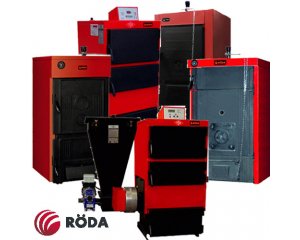
Types, types and sizes of solid fuel boilers. (material and installation)
In today's article, we will touch on the topic of choosing a solid fuel boiler . Let's try to understand the complex in simple language. Let us consider in detail: general points, we will help you understand which type of solid fuel is more profitable for you to choose a boiler, types of boilers, heat exchanger material, type of fuel loading, volatile or non-volatile, general installation recommendations.
Boilers that generate thermal energy by burning solid fuels are called solid fuel boilers. They can heat residential buildings, office space, schools, hospitals, kindergartens, museums, sports complexes, warehouses, industrial facilities, etc.
 The dimensions of a solid fuel boiler depend on the operating power supplied by the boiler. This is an important point, therefore, when buying, pay attention to the dimensions, whether it will fit in the space allotted for it. When choosing, it is better to consult a specialist. It is important to take into account the material of your walls, insulation, ceiling height, the presence of a basement, quadrature and other factors that affect the required power and size of a solid fuel boiler for your home. With the right approach, an accurate result will be achieved.
Types of fuel for boilers
Solid fuel - combustible substances:
- Firewood - pieces of wood that are also used for stoves, fireplaces, fires. If your home is surrounded by forests, firewood will be the most optimal type of fuel for you;
- Pellets or fuel pellets are raw materials compressed into pellets. Forest and agricultural waste: sawdust, bark, chips, straw, sunflower husks are pressed under high pressure. This type of fuel is used more often than others, it is considered universal and natural. It is cheaper than firewood and charcoal. It is convenient to transport and store, does not rot and does not swell.
Fuel briquettes (euro firewood) are made according to the same principle. They have a different shape and size, like blocks of trees;
- Coal is a fossil fuel. For domestic use, they are divided into three types: stone, brown and anthracite.
- Peat briquettes are crushed, pressed peat into briquettes. This species has a high ash content, it is better to use it for heating large technical rooms and production workshops. For fireplaces, solid fuel boilers for the home, this type of fuel is not suitable.
What are solid fuel boilers. Heat exchanger material
Cast iron boiler. Solid fuel boiler with cast iron heat exchanger . Such boilers are less susceptible to corrosion, reliable, retain heat longer, they need to be cleaned less often. Size is a significant advantage of cast iron boilers: smaller cast iron boilers provide the same temperatures as larger steel ones.
However, they are very heavy, which sometimes requires additional foundation masonry. Sensitive to temperature changes, from which cracks can occur. It is not recommended to use cold firewood and fill it with water. Vulnerable to shock and mechanical damage.
Steel boiler. Solid fuel boiler with steel heat exchanger . Such boilers are well tolerated by temperature extremes, mechanical impacts (shocks). They are lighter in weight and easier to transport. Easy cleaning of the heat exchanger, convenient maintenance. Repair is possible - in the event of a leak, the heat exchanger can be welded.
The only thing that can harm them is corrosion.
Fuel supply type
- Manual (filling) - loading occurs manually through the loading door;
- Automatic supply - fuel is loaded into special bunkers standing next to the solid fuel boiler. From there they enter the furnace with the help of an auger and an engine. Such devices have a high efficiency. They can work on the machine for weeks, without human participation in the process. And the duration of burning will depend only on the capacity of the bunker.
Volatile or non-volatile solid fuel boilers
This section is especially important for those people who live in settlements with intermittent power supply.
Volatile. Most solid fuel equipment depends on electricity. With the help of electricity, forced ventilation, pumps and heating are regulated.
Non-volatile. Such solid fuel equipment does not use electricity. Water circulation, smoke extraction and temperature control are all done manually.
Installation of solid fuel boilers. Recommendations. Preparation
Very important! Installation of solid fuel boilers , as well as commissioning, should be done by a competent person who will take into account the characteristics of each boiler, place, conditions and other criteria during installation.
However, we can talk about some recommendations.
Solid fuel boilers are available only for floor installation due to their large size.
It does not matter which of the solid fuel boilers you bought, it is important to properly prepare before installation: allocate a place for the boiler; prepare the room where the installation will be, pour the foundation, if the dimensions of the boiler require it, make a hole for ventilation and a chimney pipe in the wall.
When burning fuel, the amount of dust in the room increases, smoke can get inside. It is not recommended to mount the boiler close to living quarters. But following all the rules, installing a solid fuel boiler in the hallway, kitchen and other non-residential rooms is possible.
It is optimal to allocate a separate place for the boiler, preferably remotely from home. An extension to the house, equipped as it should, is suitable. Corridor or garage with sufficient space and ventilation.
It is important to ensure good ventilation - to supply fresh air, and remove burning from the room to the outside.
It is necessary to close the walls, the floor with heat-resistant material - the installation area of \u200b\u200bthe boiler. A sheet of material on the floor should protrude 70-80cm ahead of the boiler. If the heat falls out of the furnace, it will protect you from fire.
Create accessibility to the boiler with indents from the walls, for cleaning and easy maintenance.
Connect electricity. If your boiler is volatile or you need to connect additional units.
Once upon a time, solid fuel boilers were installed in places where it was not possible to connect gas installations. Today, the situation is changing. Modern solid fuel boilers can be an excellent replacement for appliances that run on resources that are constantly rising in price - natural gas and electricity. In comparison, they are not as compact and easy to use, but they have many significant advantages.
